


If your dentist has mentioned a dental crown, you might be wondering if it’s truly essential. Dental crowns are one of the most common and effective dental treatments. They don’t just enhance your smile; they fundamentally protect and strengthen teeth that are weak, broken, or heavily worn.
While crowns offer significant benefits, they are not suitable for everyone. In this guide, we will explain what a dental crown is, the key reasons it is recommended, and how to determine if you’re the right candidate.
What Are Dental Crowns and How Do They Work?
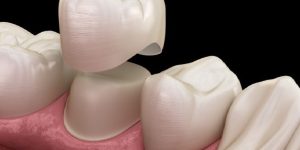
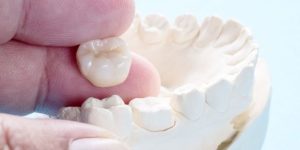
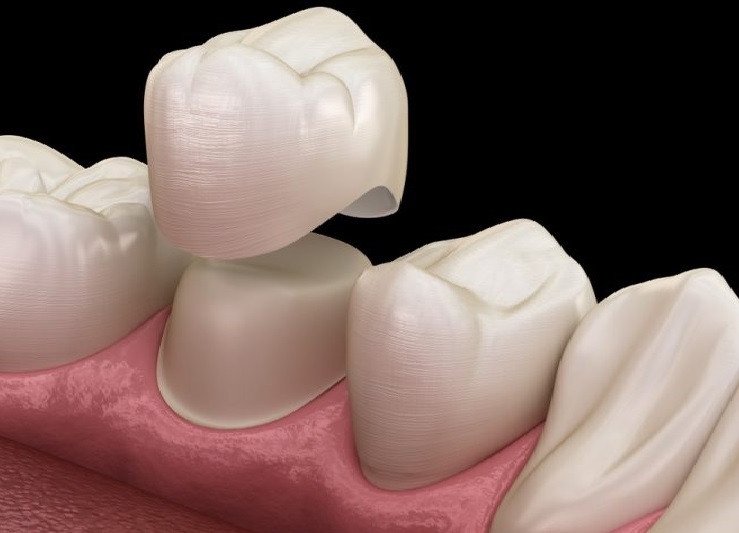
Think of a dental crown as a protective cap or “helmet” for your tooth. It’s a custom-fitted restoration placed entirely over a damaged tooth, restoring its original size, shape, and stability. Crowns can be crafted from materials like porcelain, metal, or zirconia, and they are permanently cemented into place.

Cosmetic dentistry recommends crowns when simpler treatments, such as fillings or veneers, aren’t strong enough to save the tooth. With proper care, a crown is one of the most durable ways to restore a tooth, often lasting 10 to 20 years.

Who Is a Good Candidate for Dental Crowns?
According to JADA, dentists are most likely to recommend crowns for teeth that have been fractured, cracked, or endodontically treated, or have a broken restoration. Dental crowns are a versatile solution for many common dental problems. You are likely a good candidate if you have one of the following issues:
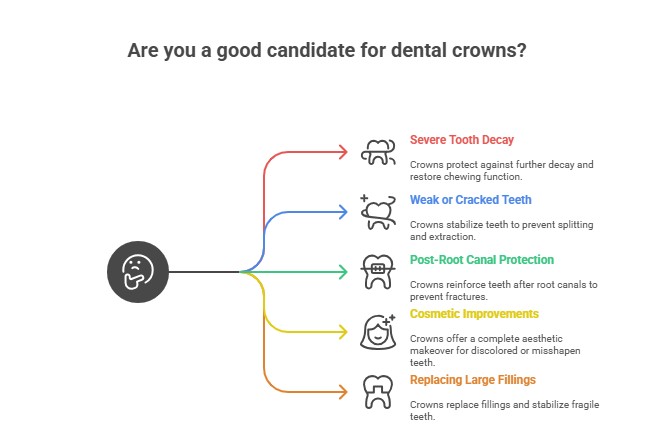
Severe Tooth Decay or Damage
When a cavity is too extensive for a standard filling, a crown is used. It fully covers the tooth, sealing out bacteria and preventing further decay, while restoring comfortable chewing function.
Weak or Cracked Teeth
Teeth can weaken from age, teeth grinding, or previous dental work. If you feel tooth sensitivity while chewing or have a visible crack, a crown can stabilize the tooth to prevent it from splitting, which could otherwise lead to extraction.
Post-Root Canal Protection
After a root canal, the tooth loses much of its natural resilience. A crown is nearly always required to reinforce the treated tooth, allowing it to withstand the daily forces of biting and chewing without fracturing.
Cosmetic Improvements
Crowns aren’t only functional and one of the best restorative treatments; they offer a complete cosmetic makeover for teeth that are severely discolored, misshapen, or uneven in shape. Unlike veneers, they cover the entire tooth, providing a dramatic and permanent aesthetic solution.
Read More: Dental Veneers vs Crowns: Pros, Cons, and Best Fit
Replacing Large Fillings
Teeth that have been repaired with multiple or very large fillings often become fragile. A crown replaces the filling and stabilizes the remaining tooth structure, significantly extending the tooth’s lifespan and reducing the risk of sudden fracture.
Who Might Not Be a Suitable Candidate?
A crown isn’t always necessary. If your tooth can be fixed with a simpler treatment, like a small filling, bonding, or a veneer, your dentist will recommend that first. Additionally, issues like active gum disease or severe bone loss must typically be managed and resolved before a crown can be successfully placed.
Do you have questions about dental crowns?
Contact Pearl Dental Group Today to decide whether this treatment suits your needs!
How does your cosmetic specialist apply a crown to your tooth?
Generally, two appointments with an expert are needed.
- First, your dentist is required to adjust your tooth cautiously. At this level, the decayed portion should be quickly removed during a root canal process to prepare your mouth. Furthermore, thin layers of your enamel should be shaved down.
- Then, your dental specialist carefully takes an ideal impression of your mouth to send it to a laboratory.
- A temporary crown will be applied to your tooth while the permanent one is being manufactured. During this time, you should be really careful about what you eat because a broken crown is always possible, and these temporary shells are really prone to cracks and fractures.
- Ultimately, your dentist will bond the temporary one to your tooth during the final appointment.
Alternative Treatments to Dental Crowns
Of course, there’s no perfect treatment for all! Depending on the extent of the tooth damage, your preference, and pre-existing factors, your dentist may suggest alternatives to dental crowns:
- Fillings: Best for minor repairs and small cavities. They are quick and cost-effective, but don’t provide the protective strength of a crown.
- Inlays and Onlays: Often referred to as “partial crowns,” these are used when the damage is too extensive for a filling but doesn’t require a full crown. They preserve more of your natural tooth structure.
- Veneers: Thin shells placed on the front of a tooth to improve color and shape. They are mainly for cosmetic issues on front teeth, not for functional restoration.
- Dental Bonding: Applying a tooth-colored resin to repair chips, cracks, or gaps. It’s less expensive but less durable than a crown.
These alternatives are effective for mild to moderate issues, whereas crowns are the go-to solution when a tooth requires maximal, long-term strength and protection.
The Perfect Treatment Depends On You!
Dental crowns are a foundational treatment that goes far beyond aesthetics. They are critical for restoring function, protecting a damaged tooth, and giving you the confidence to smile comfortably. If you experience significant tooth pain, a visible crack, or have recently undergone a root canal, consult your dentist to determine if a crown is the right solution for you.
FAQ
How do I know if I need a crown instead of a filling or veneer?
If the tooth is weak, cracked, or severely decayed, a crown provides superior protection and is usually the safer, long-term option.
Are dental crowns for cosmetic reasons only?
No. They offer both functional benefits—strengthening and protecting the tooth—while also improving its appearance.
What are the key differences in crown materials?
Porcelain crowns are natural-looking and best for visible front teeth. Metal ones are the strongest option, ideal for back molars. Zirconia crowns offer an outstanding balance of strength and natural aesthetics.
How long can a crown be expected to last?
On average, crowns last 10–20 years, depending on factors such as oral hygiene, material choice, and habits like teeth grinding.
Does the procedure hurt?
The procedure is performed under local anesthesia, so you should experience minimal discomfort.
How long do dental crowns last, and what affects their lifespan?
On average, 10–20 years, depending on oral hygiene, material choice, and habits like grinding.
Will my crown look natural, or will it be noticeable?
Modern crowns are designed to blend in and look just like your natural teeth.
Does getting a dental crown hurt?
The procedure is done under local anesthesia, so discomfort is minimal.
What are the risks of getting a dental crown?
Some patients may experience sensitivity or gum irritation, but these issues are usually temporary.
How much do dental crowns cost, and will my insurance cover them?
Prices range from approximately $ 1,500 to $ 1,900. Many insurance plans cover crowns if they’re medically necessary. Check with your provider for more information.
Have you ever tried dental crowns? Were they for cosmetic or medical reasons? Share your experience or drop your questions in the comments so others can learn from you.